Walk an older oceanfront lot on 1st Street or Ocean Front Park with an eye toward tearing down and building new, and the math looks simple at first. The block is walkable. The lot is scarce. Why not go bigger, go up, push the footprint toward the water the way the house across the street already has.
Then you find the Coastal Construction Control Line on a survey, assume that is the only obstacle between you and a permit, and move forward planning around it. That assumption is where most oceanfront rebuild timelines in Jacksonville Beach start to slip. The state line is real, but it is not the line that will decide what you can build. The city drew its own, and it sits closer to your front door than the one everyone researches first.
Two Lines, Not One
The Coastal Construction Control Line is a state jurisdictional boundary. Florida's Department of Environmental Protection establishes it county by county to mark the part of the beach and dune system that is subject to severe fluctuation during a major storm. It is not itself a setback or a building line. It is the point at which the state's permitting authority begins, layered on top of whatever the city already requires.
Jacksonville Beach layers something stricter underneath it. The city requires new construction to hold a 100-foot setback from the erosion control line established by the U.S. Army Corps of Engineers, and it grants variances only through demonstrated hardship and a coastal engineering analysis. That erosion control line and the state's CCCL are two different reference points, set by two different agencies, for two different purposes. A lot can sit entirely landward of the CCCL and still fall inside the city's tighter local setback, which means the state might clear a project the city won't.
For Duval County's Atlantic coastline generally, the CCCL tends to run close to the primary dune crest or the landward toe of the frontal dune system, and Jacksonville Beach's own municipal code treats coastal construction as any work with a physical effect on shore or inlet processes, or any portion of work located seaward of the state line. Read those definitions together and the practical takeaway is this: knowing where the CCCL falls on your survey tells you almost nothing about where the city's line falls, and the city's line is usually the one that constrains the footprint you actually want.
What Counts as a Repair, What Counts as an Addition
Once you know which line governs your lot, the next question is what kind of project you are proposing. Coastal permitting draws a real distinction between fixing what exists and expanding it.
| Project type | Typical review path |
|---|---|
| Repairs and minor maintenance | Often qualifies for exemption or simplified review |
| Additions and structural work | Requires full CCCL review, engineering study, no shortcut |
| Exterior lighting, windows, doors, or glazing changes | Triggers the city's sea turtle lighting compliance review regardless of project size |
| New construction or rebuild seaward of the line | Full state and local review, foundation and elevation standards apply |
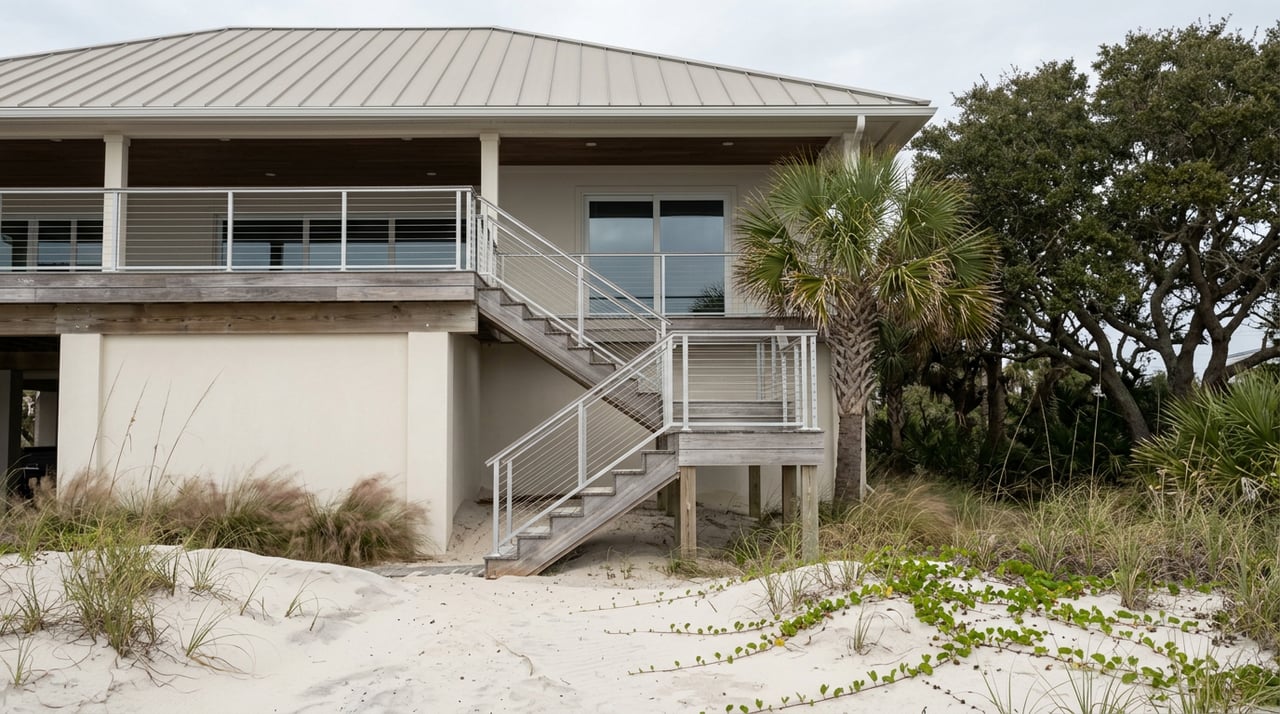
That last row matters most for older oceanfront homes, the ones built in the 1960s through 1980s that dot Jacksonville Beach's oceanfront streets. A straightforward re-roof or window swap may move quickly. The moment a renovation becomes an addition, or a rebuild replaces the original footprint, the project answers to the same engineering scrutiny as new construction, including foundation design and drainage plans meant to keep the work from destabilizing the dune system next door.
Homes in the high-velocity flood zones along this coastline carry their own structural rules on top of the coastal setback question. Properties elevated on pilings must use breakaway walls below the base flood elevation, and any enclosed space below that elevation is limited to parking, building access, or storage rather than living area. An older oceanfront house that already meets these standards is worth more to a buyer planning to renovate than an equally priced house that does not, even if the two look similar from the street.
The Calendar Nobody Puts on the Listing
Permitting isn't the only clock running on an oceanfront project here. Jacksonville Beach's own beach and bulkhead ordinance defines a sea turtle protection area that runs from 20th Avenue North, also called Seagate Avenue, south to the county line at Duval Drive and Ponte Vedra Boulevard. Any renovation that touches exterior lighting, windows, exterior doors, or glazing inside that stretch has to comply with the city's lighting standards, regardless of how far the work sits from the CCCL.
Layered on top of that geography is the calendar. Sea turtle nesting season runs roughly March through October along Florida's Atlantic coast, and it restricts both construction activity and lighting on beach-facing work during that window. A buyer who closes in late winter and plans a spring renovation may find the most convenient construction season is also the most restricted one. That is not a reason to avoid an oceanfront purchase. It is a reason to build the calendar into the offer, not into the punch list after closing.
The Timeline Tax
None of this moves through a single office. A project seaward of the control line typically needs sign-off from the state's environmental permitting program, the city's own building department, and in some cases the Army Corps of Engineers, since the erosion control line the city measures from is a federal reference point in the first place. Builders who work oceanfront lots along this stretch of Northeast Florida's coast routinely tell clients to plan for three to six months of additional review time compared to a comparable inland renovation, and that estimate assumes the survey work and pre-application meetings happen before the architect finalizes drawings, not after.
That extra runway rarely shows up in a listing description. It shows up in a closing timeline when a buyer assumes a summer rebuild is a summer project and discovers it is actually a summer-through-following-spring project once every agency has weighed in.
What This Means If You're Standing on the Lot
I designed and built my own waterfront home on Doctor's Lake, and the lesson that carried over from that experience isn't about any single rule. It's that waterfront property in Northeast Florida almost always answers to more than one authority at once, and the buyer who identifies every layer before writing an offer ends up with a design that fits the first time, rather than one that gets redrawn under a permitting deadline.
For Jacksonville Beach specifically, that means checking three things before falling for an older oceanfront house on the promise of a future rebuild: where the CCCL actually sits on that parcel, whether the city's 100-foot local setback pulls the buildable envelope in further than the state line does, and whether the scope you're picturing counts as a repair or an addition under both agencies' review. Those answers change the math on what a given lot is actually worth to you, sometimes more than the listing price does.
Market conditions add one more layer worth knowing. As of September 19, 2026, Jacksonville Beach was sitting in what one local market snapshot described as a balanced market, with roughly four months of supply and a trailing 12-month median sale price near $615,000. A market that isn't racing gives a buyer more room to do the permitting homework before closing rather than after, which is exactly the point in the process where this kind of research pays for itself.
A Few Questions Worth Asking Before You Write an Offer
Does the 100-foot local setback apply to every home in Jacksonville Beach, or only oceanfront parcels? It applies to new construction near the coast, measured from the Army Corps-established erosion control line. Homes well inland of the beach are not affected by this particular rule, though they may answer to their own local building setbacks.
If I'm only renovating, not adding on, do I still need to worry about the CCCL? Repairs and minor maintenance often qualify for exemption or a simplified review. The line hardens once a project becomes an addition or involves structural work, so the honest answer depends on the scope, not just the address.
Where exactly do these two lines sit on a specific property? That requires a current survey and a pre-application conversation with the relevant permitting offices, since both the CCCL and the local setback line can vary lot to lot along the same block based on dune elevation and prior storm history.
If you're looking at an older home along Jacksonville Beach's oceanfront and want to understand what a lot will actually support before you fall for the location, I'd rather walk that conversation with you before you write an offer than after. Let's Connect.